Showing posts with label sign making. Show all posts

Thursday, January 11, 2018

The Most Important Rule in Making Billboards and Signs

Often, when it comes to outdoor banners, it’s best to keep it simple and adhere to the adage “less is more.” This is because the size, style, and location of the ad will depend on its print quality. Namely, if you’re zipping down the freeway at seventy-five miles per hour, you’ll only have two seconds to view and read a billboard.

Not much time, is it? The time potential customers will have to read your billboard is why I dubbed it the “2-Second Rule.” Typically, your billboard is being seen from at least 100 yards (or 300 feet) away, so the font and graphics need to be 50 DPI (dots per inches), meaning that, up close, your billboard would be illegible. But at a distance, it will be able to be seen clearly.

The number one mistake advertisers make is cramming lots of copy onto a sign – so much so that it can’t be read while driving. After all, if your sign can’t be read in two seconds, you’re missing tons of potential customers. Think of it this way: don’t put an entire Bible verse on a sign, but direct readers to look up the verse themselves by having your church’s name and, say, Psalm 91: 1-2. If you were to write the whole verse, your sign would read:

“Whoever dwells in the shelter of the Most High
Will rest in the shadow of the Almighty.
I will say of the Lord, “He is my refuge and my fortress,
my God, in whom I trust.”
My Town Church ~ Sundays, 10AM

Realistically, that can’t be read in two seconds. But “Join us at My Town Church on Sundays at 10AM” with a picture of a Bible with Psalm 91:1-2 can be. The same goes for sales. If you own an automobile repair shop, you can say “Labor Day Sale at Smith Auto Repair, Select Tires 20% Off!” rather than listing every tire that’s included in the sale and its marked-down price. Typically, you only have one chance to make a first impression.

Photo from larrybrownsports.com
You have more options than a billboard to attract new customers, though. Let’s say you own a candle shop and you want to announce an end-of-the-year clearance sale to make room for new inventory. You decide that you want to have a “Buy 3, Get 1 Free Sale” for the week of December 26th through January 2nd. Since it’s your first year in business, you can’t afford a billboard, but you want to get the word out. Fortunately for you, though, you’re located on a busy strip where cars drive by at forty miles per hour.
Due to expenses, you choose to hang a banner on the front of your building that says:

“All Candles
Buy 3, Get 1 Free,
Ends February 4th.”

Look at how short and concise that message is. You don’t want to list the scents, prices, sizes, etc. because all of that information couldn’t be read in such a brief amount of time. So, just invite customers to your place of business to see what you have to offer.

Exceptions to the “2-Second Rule”

As the saying goes, there’s always an exception to the general rule. At times, more information is needed than just “SALE.” An example of this would be for a political fundraiser. Let’s say that you organized a successful and lucrative fundraiser for a local politician who is running for mayor. After he is elected, you want to thank those who donated their time and money to his campaign. So, at the entrance of the banquet hall where the reception is being held, you hang a banner that says “THANK YOU!” with a list of the donors’ names. In this case, it’s appropriate to have a high-quality banner with lots of writing.

And by high-quality I don’t mean vinyl. If you go to a print shop and ask for outdoor fabric, they may not have anything to fit your needs because not all shops offer dye-sublimation printing. So, browse the Internet and find a printer that can do dye-sublimation and order the banner thanking the donors that will double as a lovely, eye-catching decoration.

Poly flag material, for instance, is nice while nylon banners tend to have a plastic-like appearance. Poly flag is cloth and gives the banner a more classy, high-end look, so it would be perfect for the thank you reception. For more about large format poly flag banners, fabric signs, and billboards, visit this page.


Sunday, August 27, 2017

How to Make Signs Part 4 - Calculating the Area of Lettering

In this section, Part 4 of this series, we’ll start by looking at more precise calculations for determining the area needed for a sign or banner.

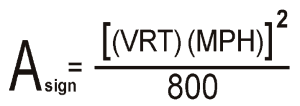
formula in calculating sign copy lettering sizes
Personally, I am not a big fan of algebra, but sometimes the easiest way to calculate what the Area of a sign (Asign) is by using one, especially if someone else has already done the work to come up with it, which, in our case, the USSC has already done for us.

The only part of the equation that is left out is the negative space calculation, which is fixed at a 40/60 ratio with the copy area, or Copy Area x 1.5. Note that number rounding – which I do frequently – will yield a slight variance in copy area/negative space.

To read more of this and view image presentations about this, go here: https://www.visigraph.com/signs/part-4-the-science-of-outdoor-signs-banners/.

For the final part of this series, read this.

Friday, August 25, 2017

How to Make Signs Part 3 - Measuring the Copy Area

As we have talked about in parts one and two in this article, just throwing a banner up on a wall or a sign on a pole could be some of the worst money you’ll ever waste if you don’t have a “scientific” method for determining the size of letters, negative space, and viewing distance for your sign, coupled with the reaction time an ordinary driver will have when they view your sign at 35 mph – give or take.


In this article, we’ll talk about copy area in combination with negative space to give your potential customer the best chance of reading your business advertising banners or main identification signage.

The copy area of any banner or sign is the area of that sign covered by lettering, including the space between the letters, but not between lines of copy....

Full article can be viewed at https://www.visigraph.com/signs/part-3-the-science-of-outdoor-signs-banners/

For Part 4, click this.